You may remember that a few weeks ago there a big outcry because Wikipedia blacked out for the day because of a proposed American law called SOPA which, due to the US’s federal influence on the internet, would have had a chilling effect on websites you use everyday – Wikipedia, Facebook, Twitter, Youtube would have had to close down, move operations abroad or effectively remove most of their functionality. After the worldwide protests against the proposed act, it was withdrawn.
SOPA was billed as an anti-piracy law and yet did nothing to address the negative aspects of commercial copyright infringement whilst curbing free speech and killing the space that many technology companies (think Facebook, Google), are allowed to operate in.
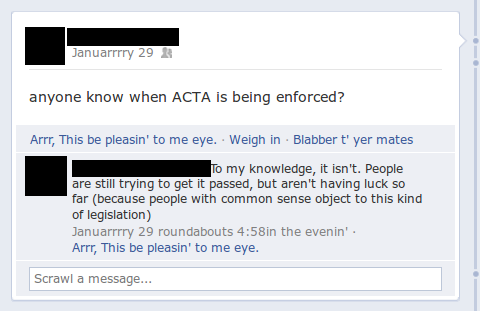
ACTA – The Anti-Counterfeiting Trade Agreement – is another similar piece of legislation except that, as this is a trade agreement, it applies to a group of countries. Like SOPA it has been developed on behalf of rights holders collectives such as the MPAA with no thought for the best interests of the citizens of the countries concerned.
One of the most deplorable thing about ACTA has been the secrecy around the agreement right from the get go. It wasn’t until drafts of the agreement started to be leaked onto the internet (ironically, this being one of the kinds of things the agreement will be used to tackle), that we started to get an idea of the scope of the proposed agreement.
ACTA will have sweeping and wide ranging effects, Wired UK Magazine explains things in great detail in a FAQ style article.
Given the secretive manner in which the agreement has been conducted and the completely disproportionate aspects of it regarding the internet and new technology, there has been a good deal of controversy surrounding it.
The European parliament’s rapporteur for ACTA, resigned on 26 January 2012 denouncing the treaty
“in the strongest possible manner”
for having
“no inclusion of civil society organizations, a lack of transparency from the start of the negotiations, repeated postponing of the signature of the text without an explanation being ever given, [and] exclusion of the EU Parliament’s demands that were expressed on several occasions in [the] assembly,”
concluding with his intent to
“send a strong signal and alert the public opinion about this unacceptable situation” and refusal to “take part in this masquerade.”
In Poland there have been mass protests and in Parliament, a group of politicians held up Guy Fawkes masks in support of the protests against the act and as a result, ratification of ACTA has been suspended.
The Slovenian ambassador to Japan, Helena Drnovšek-Zorko, said in a statement issued on 31 January 2012:
I signed ACTA out of civic carelessness, because I did not pay enough attention. Quite simply, I did not clearly connect the agreement I had been instructed to sign with the agreement that, according to my own civic conviction, limits and withholds the freedom of engagement on the largest and most significant network in human history, and thus limits particularly the future of our children.
What can I do to stop it?
There are protests around the Britain this Saturday 11th February – the BBC even has an article about them.
If you’ve never been to anything like this, go!
It’ll be fun and you’ll make a difference.
It was protests that finished SOPA and it will be protests from people like you that kill ACTA.
You can also write to your MEP about ACTA and tell them why you don’t like it. Even better, invite them along to a protest! as well as signing a petition.